

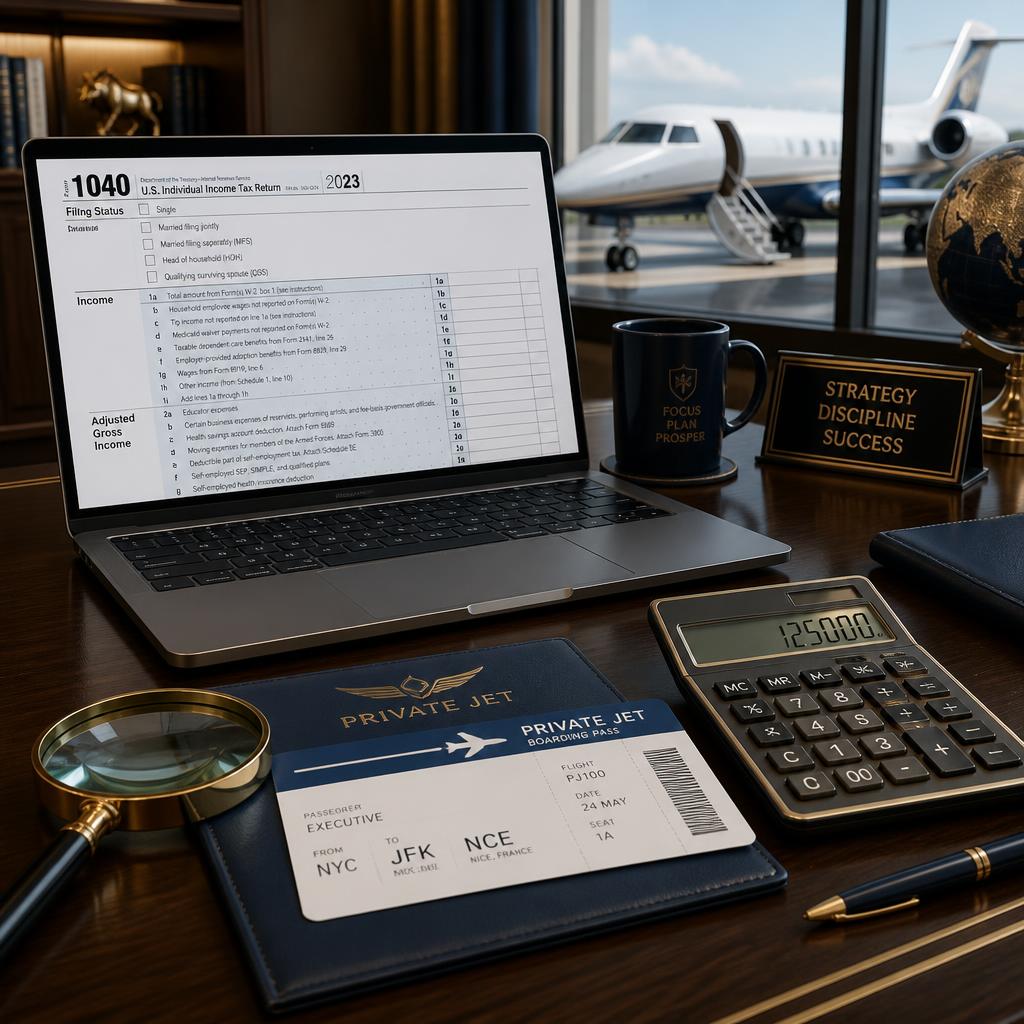
Can you deduct a private jet charter on your taxes? The short answer is yes—but with significant caveats. The longer answer requires understanding the difference between business travel and personal travel, entertainment versus non-entertainment, and the ever-watchful eye of the IRS. This guide breaks down everything you need to know about the private jet charter tax deduction. We will cover what qualifies, what does not, and how to stay compliant.
The Foundation: Ordinary and Necessary
The IRS allows deductions for expenses that are “ordinary and necessary” to your trade or business.
For travel, this means the trip must have a clear business purpose. Flying to meet a client, inspect a property, or attend a board meeting? That is deductible.
Flying to a vacation destination with a brief stop at a client’s office? That is where things get complicated.
Under IRS rules, if a trip combines business and personal travel, only the portion attributable to business days is deductible.
For a private jet charter tax deduction to hold up under audit, you need to document the business purpose of every flight.
The 50% Business Use Test
Here is where many business owners get into trouble.
For accelerated depreciation (if you own the aircraft), the IRS requires that the aircraft be used for more than 50% business purposes.
If your aircraft fails this “predominant business use” test, you lose the ability to claim accelerated depreciation. You must instead use the alternative depreciation system—which is significantly less favorable.
For chartering (as opposed to owning), the rules are simpler but still strict. You can deduct the cost of the charter as a business travel expense, provided the trip is primarily for business.
Entertainment vs Non-Entertainment
The Tax Cuts and Jobs Act of 2017 made a crucial distinction.
Entertainment expenses are generally not deductible. If you are flying to a golf tournament or a concert, do not expect a private jet charter tax deduction.
However, non-entertainment personal flights may be deductible in certain circumstances. Examples include travel for medical purposes, to attend a family member’s funeral, or to participate in charitable activities.
For business flights that have a personal component, the costs must be allocated between business and non-business purposes.
The Documentation Imperative
The IRS has intensified its audit of private aircraft usage. In 2024, the agency launched a “Business Aircraft Campaign” specifically targeting high-income taxpayers and corporations.
To survive an audit, you need meticulous records.

For every flight, document:
- The date and route
- The passengers and their relationship to the business
- The business purpose of the trip
- The agenda and meetings conducted
The IRS requires taxpayers to substantiate each element of the expenditure. Vague descriptions will not suffice.
Chartering vs Owning: A Tax Perspective
For most business travelers, chartering offers a simpler tax picture than owning.
When you charter, the expense is a straightforward business travel deduction. You pay, you fly, you deduct.
When you own, you must navigate depreciation schedules, bonus depreciation rules, and the complex imputed income rules for personal use.
The One Big Beautiful Bill Act (OBBBA) , signed into law in July 2025, permanently restored 100% bonus depreciation for qualifying business property—including aircraft—acquired and placed in service after January 19, 2025.
This means business owners who purchase an aircraft can now deduct the entire cost in the first year, provided the aircraft is used more than 50% for business.
However, this complexity is precisely why many businesses prefer chartering. No depreciation schedules. No imputed income calculations. Just a simple, deductible business expense.
The Family Travel Trap
One of the most common audit triggers is family travel.
If a business owner brings family members on a business trip, the family’s travel is considered a “Taxable Fringe Benefit”. The cost of their travel must be included in the owner’s gross income.
For federal income tax purposes, the family’s travel is not deductible—even if the owner’s travel is.
Practical Tips For Maximizing Your Deduction
- Keep a travel log. Record the business purpose of every trip before you depart.
- Separate business and personal. If you extend a business trip for personal days, allocate the costs appropriately.
- Consult a tax professional. Aviation tax is complex. A specialist can help you structure your travel to maximize legitimate deductions.
- Use a charter broker with transparent billing. Clear invoices make documentation easier.
Platforms like Villiers.ai provide detailed invoices that clearly separate the cost of the flight from ancillary services. This clarity is invaluable when tax season arrives.
The Bottom Line
A private jet charter tax deduction is absolutely available for legitimate business travel. But the key word is legitimate.
The IRS is watching. Documentation is non-negotiable. And when in doubt, consult a professional.







Leave a Reply