

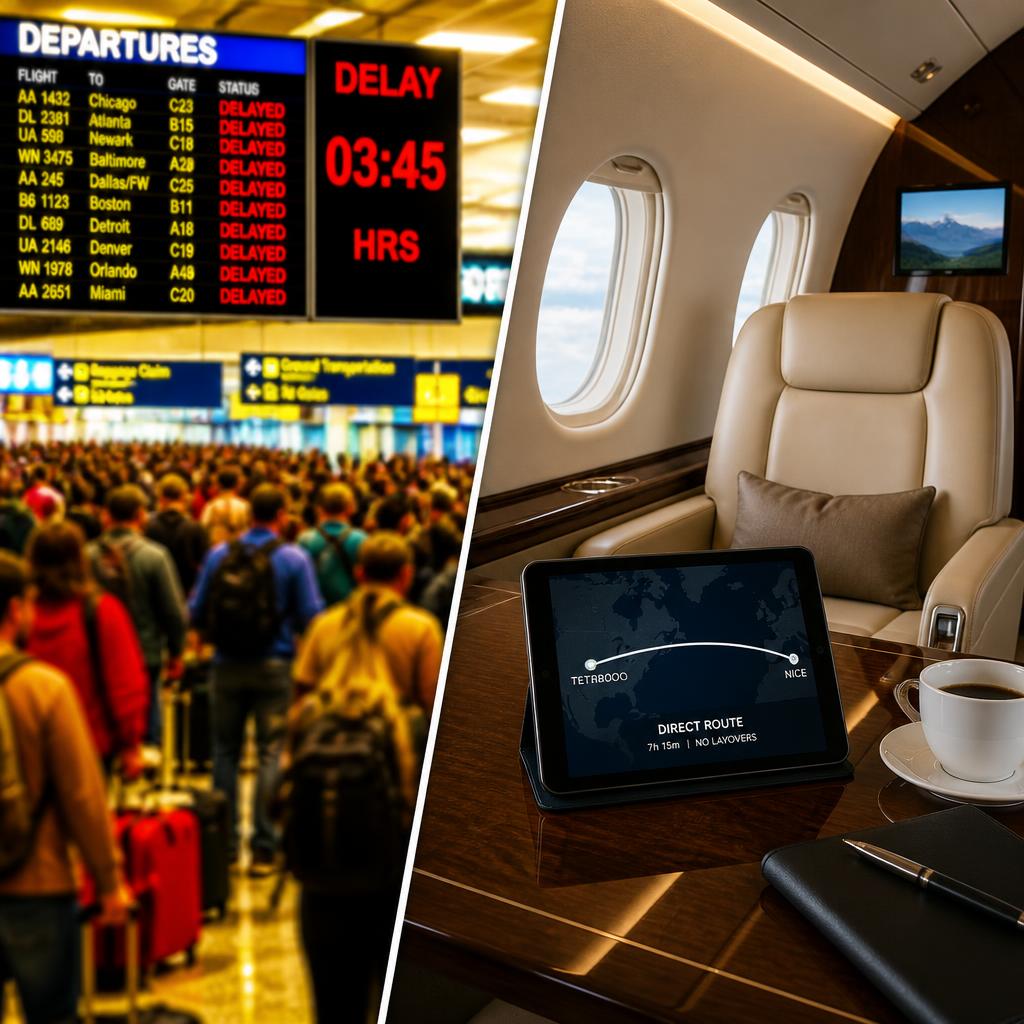
What is the real price of a four-hour layover? Most accountants would say it is the cost of a sandwich and a coffee at the terminal food court—roughly twenty bucks. But that is a bookkeeper’s answer, not a strategist’s answer. For a business owner generating substantial annual revenue, a four-hour layover carries a hidden price tag that rivals the cost of the airline ticket itself. When you calculate the cost of airport layover, you must factor in lost billing rates, drained cognitive energy, and the sheer opportunity cost of being stuck in a sterile terminal while your competitors are closing deals.
Today, we are going to peel back the layers of commercial travel expenses and compare them directly to the efficiency of private on-demand charter. By the end, you will see why many high-performers view layovers as “negative leverage.”
Calculating Your Hourly “Burn Rate”
To understand the true cost of airport layover, you first need to know your personal hourly earning capacity.

Let us use a conservative figure: A CEO of a mid-sized firm might earn $2 million annually. Assuming 2,000 working hours a year, that equals roughly $1,000 per hour.
Now, consider a standard business trip from Austin to San Francisco. You have a connecting flight through Dallas. That layover is scheduled for 2.5 hours, but with delays, it stretches to 4 hours.
You just burned $4,000 of potential revenue generation—sitting on a hard plastic chair, listening to gate announcements.
The Four Layers of Layover Cost
When we analyze the cost of airport layover, we must categorize the losses into four distinct layers:
- The Direct Time Cost: As mentioned, this is the hourly rate multiplied by the time spent waiting. If you travel bi-weekly with layovers, this quickly racks up to $30,000–$50,000 annually.
- The “Context Switching” Penalty: You cannot do deep work in a noisy terminal. Every time you get into a flow state and are interrupted by a boarding call, your brain takes 15 minutes to refocus. This cognitive friction reduces the quality of any work you do manage to complete.
- The Fatigue Tax: A layover does not just cost you time; it costs you energy. By the time you reach your final destination, you are drained. This means your first meeting the next day suffers. Poor performance in a single client presentation can cost you a seven-figure contract.
- The Meals & Incidentals: While minor, the inflated prices at airport restaurants and the extra Uber rides due to flight changes add up.
Direct Route vs. Indirect Route: The Math
Let us compare a direct private flight versus a commercial connecting flight for that Austin to San Francisco journey.
Commercial (with layover):
- Departure to Airport: 1 hour.
- Buffer: 2 hours.
- Flight 1 (Austin to Dallas): 1 hour.
- Layover: 4 hours.
- Flight 2 (Dallas to SFO): 3.5 hours.
- Deplaning & Baggage: 0.5 hours.
- Total Door-to-Door: 12 hours.
Private Charter (direct):
- Departure to FBO (Private Terminal): 0.5 hours.
- Buffer: 15 minutes.
- Flight Time (Direct): 3.5 hours.
- Deplaning: 5 minutes.
- Total Door-to-Door: 4.25 hours.
You save 7.75 hours. At $1,000/hour, that is a $7,750 saving per trip. If you make this journey six times a year, you have saved $46,500 in opportunity cost.
How Layovers Derail Quarterly Earnings
The cost of airport layover is not just a micro-problem; it is a macro-threat to your quarterly earnings.
Consider Q3 planning. You need to visit three cities: Denver, Phoenix, and Las Vegas. With commercial airlines, you cannot do this in one day without risking missed connections. You would have to stretch it over three days, incurring hotel costs, per-diems, and three days of lost office presence.
With a private charter, you can do all three in a single “crossover” day (which we will explore in a later article). You leave at 7:00 AM and are back home by 9:00 PM.
Furthermore, layovers increase the risk of lost baggage or missed meetings. If a commercial delay causes you to miss a signing ceremony, the financial repercussions are catastrophic.
Mitigating the Cost with Smart Chartering
How do you avoid the cost of airport layover without breaking the bank?
First, look for “direct routes” exclusively. If you must fly commercial, never book a connection under 2 hours—it is a trap.
Second, consider light jets for regional travel. These aircraft have access to smaller municipal airports. This means you can avoid major hubs like Atlanta or Chicago entirely, bypassing the layover problem by skipping the hub-and-spoke model entirely.
Platforms like Villiers.ai aggregate thousands of aircraft. By inputting your departure and destination, you can instantly see which aircraft can take you direct. Often, the cost of a light jet is comparable to a First-Class commercial ticket when you factor in the multi-city stops you would otherwise need.
The Ultimate Perspective Shift
Stop viewing layovers as “travel time” and start viewing them as “capital expenditure.”
If you would not willingly pay $4,000 to sit in an airport food court, why are you allowing your schedule to force you to do so? The cost of airport layover is the hidden tax that successful business owners pay for choosing convenience over efficiency.
By switching to direct, on-demand chartering, you are not spending more money; you are buying back your time at a discount.







Leave a Reply