

Should you buy or should you charter? It is the fundamental question of private aviation. And the answer is rarely simple. A private jet ownership vs charter comparison requires looking beyond the hourly rate. You need to consider capital commitment, fixed costs, utilization, tax implications, and your long-term travel patterns. This guide breaks down the real costs of both options. Consequently, we will help you determine which path makes financial sense for your specific situation.
The Cost Structures: Two Very Different Models
The first thing to understand is the fundamental difference in cost structure.
Chartering is a pure variable cost. You pay only when you fly. Hence, no upfront capital, no ongoing fixed costs, no management headaches.
Ownership combines fixed costs (which exist whether you fly or not) with variable costs (which increase with usage).
The fixed costs of ownership are substantial:
- Crew salaries: $150,000 to $400,000+ annually per pilot
- Hangar and storage: often exceeding $100,000 per year
- Insurance: tens to hundreds of thousands annually
- Management fees, training, and subscriptions
Variable costs include fuel, maintenance, landing fees, and catering.
The Break-Even Point in Private Jet Ownership vs Charter
When does ownership become cheaper than chartering?
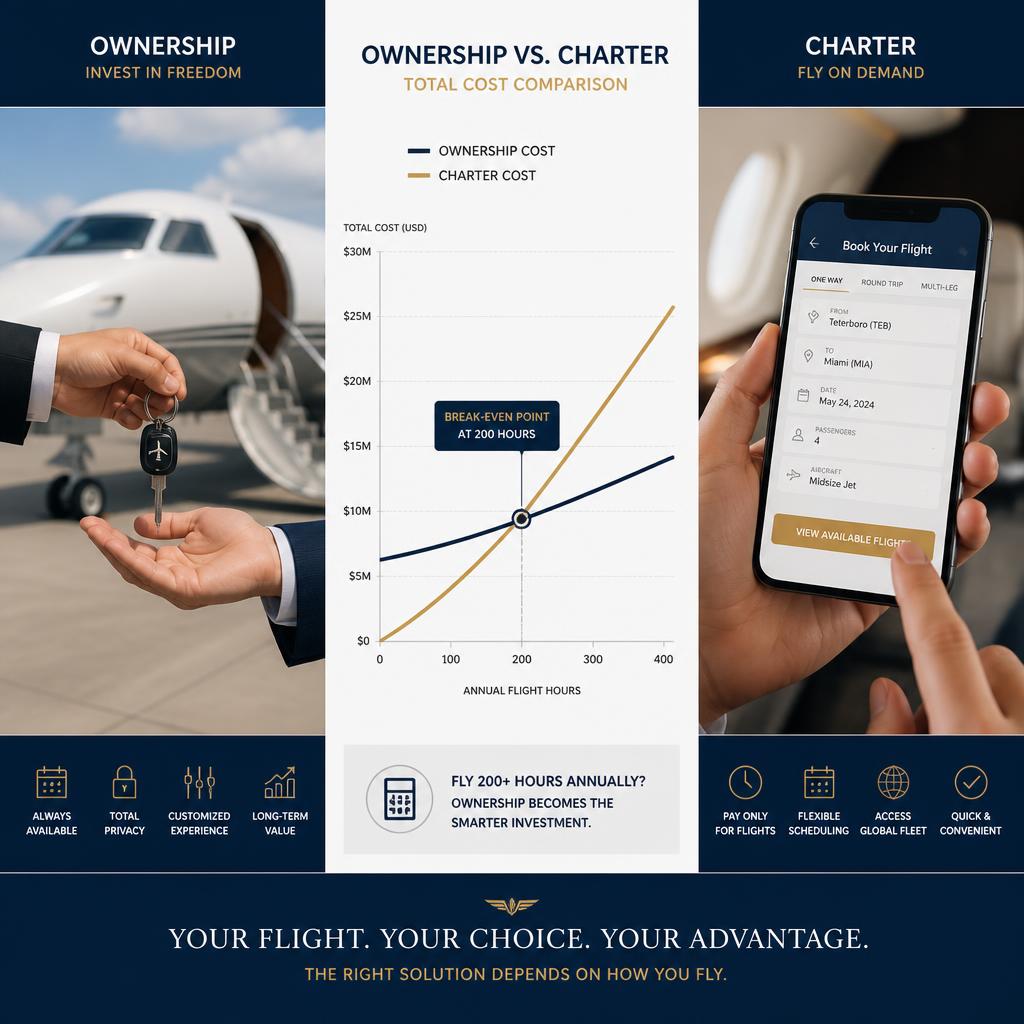
Industry consensus places the break-even point for a private jet ownership vs charter decision at roughly 200 flight hours per year.
Below 200 hours, chartering is almost always more cost-effective. Above 200 hours, ownership begins to make financial sense.
Some analysts suggest the break-even can be as low as 150 hours for turboprops. But for most business jets, the 200-hour threshold is a reliable benchmark.
The Capital Commitment of Private Jet Ownership vs Charter
Ownership requires significant upfront capital.
A new light jet costs $3 million to $5 million. A super-midsize runs $15 million to $25 million. An ultra-long-range heavy jet can exceed $75 million.
Fractional ownership offers a middle ground, with entry points typically starting at $1 million or more.
Chartering requires no capital commitment whatsoever. This is a major advantage for businesses that prefer to preserve capital for core operations.
The Control Factor in Private Jet Ownership vs Charter
Here is where the private jet ownership vs charter comparison gets interesting.
Ownership offers total control. The aircraft is available whenever you need it. You can customize the interior. You can leave your equipment on board.
Chartering offers flexibility without responsibility. You choose the aircraft that fits each specific mission. Thus, you are not locked into a single aircraft type. You do not worry about maintenance or crew scheduling.
For businesses with unpredictable travel patterns, chartering often provides better “control” because it offers access to a diverse fleet rather than a single aircraft.
The Tax Implications
As discussed in the article, Private Jet Charter Tax Deduction Strategies, ownership offers significant tax advantages—particularly with the reinstatement of 100% bonus depreciation.
However, these tax benefits come with compliance burdens. The IRS is actively auditing aircraft usage. Documentation requirements are stringent.
Chartering offers simpler tax treatment because the charter cost is a straightforward business travel deduction. No depreciation schedules. No imputed income calculations.
The Underutilization Risk
Here is a sobering statistic: around 80% of privately-owned aircraft end up being underutilized.
Because of that, capital is tied up in an asset that sits idle. The fixed costs continue regardless.
Chartering eliminates this risk entirely. You pay only for the hours you actually use.
The Hybrid Approach of Private Jet Ownership vs Charter
Many businesses do not choose between ownership and chartering. They use both.
Own a primary aircraft for your most frequent routes. Charter supplemental lift when your aircraft is in maintenance, when you need a different aircraft type, or when multiple executives need to travel simultaneously.
This hybrid approach offers the best of both worlds: the control of ownership with the flexibility of chartering.
Making the Decision: A Framework
To make a private jet ownership vs charter decision, ask yourself these questions:

- How many hours will you fly annually? Below 200 hours? Charter. Above 200? Consider ownership.
- Is your travel pattern predictable? If you fly the same routes at the same times, ownership makes sense. If your travel is sporadic, charter wins.
- Can you handle the management burden? Ownership requires managing a management company, dealing with maintenance issues, and navigating complex regulations.
- What is your capital position? Can you afford the upfront investment without compromising your core business?
- Do you value fleet diversity? Chartering gives you access to different aircraft for different missions. Ownership locks you into one type.
A Note on Fractional Ownership
Fractional ownership sits between chartering and full ownership.
You buy a share of an aircraft (typically 1/16 to 1/4), pay monthly management fees, and pay an occupied hourly rate.
Fractional ownership makes financial sense for travelers flying roughly 25 to 100 hours per year.
It offers guaranteed availability without the full capital commitment of ownership. But it comes with its own complexities—including asset risk and monthly fees that continue whether you fly or not.
The Bottom Line
The Bottom Line
The private jet ownership vs charter decision is not about which is “better.” It is about which is better for you.
For most business travelers flying fewer than 200 hours annually, chartering is the clear winner. It offers flexibility, simplicity, and capital preservation.
For high-frequency flyers with predictable patterns, ownership can deliver superior economics—if you can manage the complexity.
Explore your options through Villiers.ai . Compare charter costs for your specific routes. Get a clear picture of what on-demand travel actually costs. Then make an informed decision.






Leave a Reply