


Speed wins. In today’s hyper-competitive business landscape, the gap between winning and losing often comes down to who gets there first. Who meets the client face-to-face before the competition does. Who inspects the acquisition before the bidding war begins. Who closes the deal while others are still waiting at the gate.
That is the essence of private jet competitive advantage.
For decades, private aviation was viewed as a perk—a reward for success rather than a driver of it. But that perception is shifting rapidly. More than 84% of C-suite leaders now express interest in private aviation, driven primarily by time savings and schedule control. Corporate spending on private air travel is up nearly 77% compared with 2020.
The numbers tell a clear story. Private aviation is no longer just about luxury. It is about leverage.
Why Time Is Your Ultimate Competitive Weapon
Consider this fundamental truth: every executive has the same 24 hours in a day. The difference lies in how those hours are deployed.
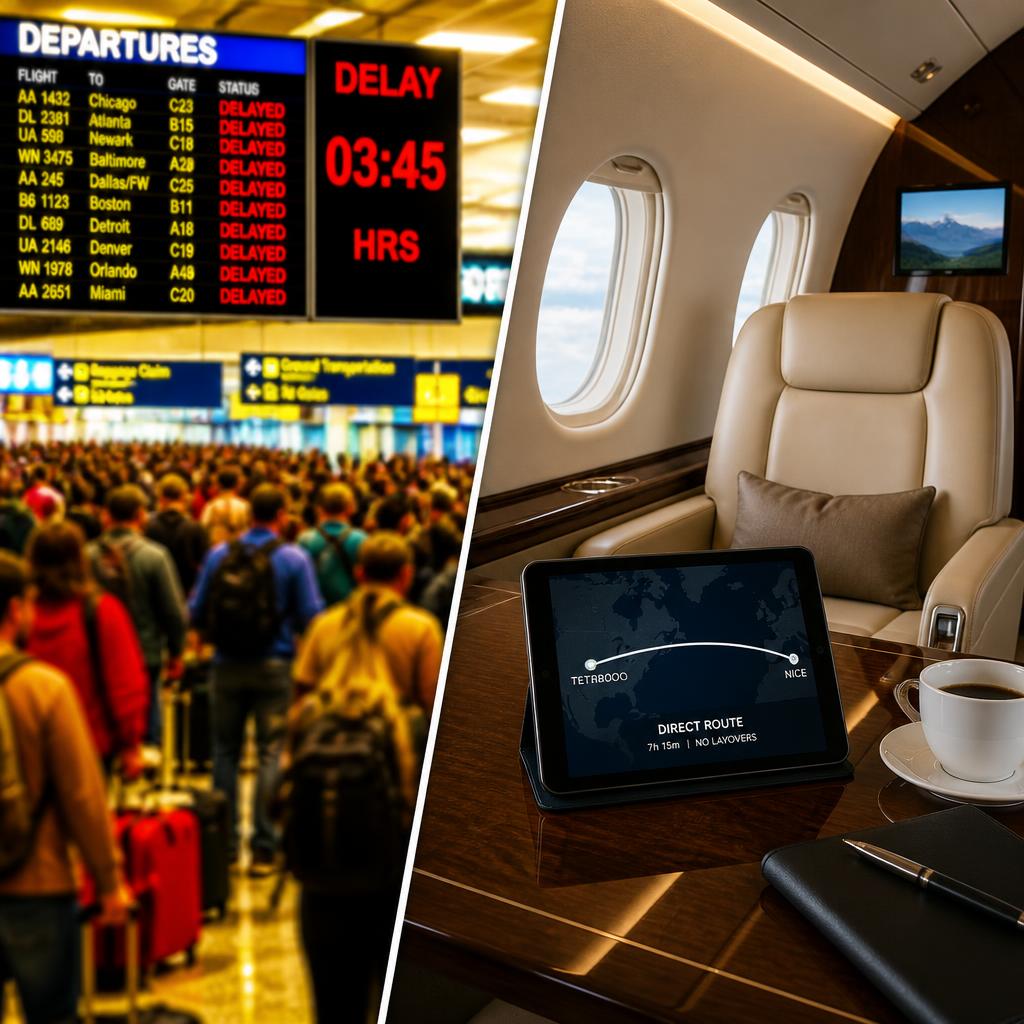
Commercial travel consumes vast amounts of time that could be spent on strategic thinking, client relationships, or simply resting. Long security lines, layovers, rigid schedules, and airport congestion eat away at the most precious resource a leader possesses.
Private jet competitive advantage emerges from reclaiming that wasted time. When you eliminate the commercial drag, you gain back hours—sometimes days—that your competitors are still spending in transit.
One CEO of a major charter company puts it bluntly: private aircraft are “time machines”. They compress journeys that would take days into hours. They transform what was once a logistical burden into a strategic asset.
Multi-City Advantage
Here is where private jet competitive advantage becomes tangible.
Imagine needing to visit three clients in three different cities. Commercially, this is a three-day ordeal. You fly to City A, spend the night. Fly to City B the next day, spend another night. Fly to City C on day three.
Privately, this is a single day. You leave at 7:00 AM, visit all three clients, and return home for dinner.
The competitive implications are profound. You can respond to market opportunities instantly. You can be in a boardroom in Chicago and a factory in Dallas on the same afternoon. Your competitors are still checking in for their flights while you are already shaking hands.

Access to the Inaccessible
Another dimension of private jet competitive advantage is access.
Commercial airlines serve roughly 500 airports in the United States. Private aviation serves over 5,000. This means you can land closer to your destination—often at smaller, regional airports that are minutes away from your meeting rather than hours.
For meetings at private properties, remote facilities, or confidential locations, private flights provide direct access that commercial carriers simply cannot match. This level of access supports both productivity and discretion, allowing executives to focus on what matters most.
The Brand Signal
Private jet competitive advantage is not just operational—it is perceptual.
When you arrive at a client meeting via private charter, you send a signal. Not of arrogance, but of seriousness. You are communicating that this relationship matters enough to prioritize. That you value their time as much as your own.
This is particularly impactful in industries where trust and relationship-building are paramount. High-ticket aviation sales are built on relationships, not quick transactions. Clients choose brokers and partners they trust. Arriving refreshed, prepared, and on time—every time—builds that trust faster than any PowerPoint ever could.
The Productivity Multiplier
Beyond the logistics, private jet competitive advantage manifests in cognitive performance.
Commercial travel is exhausting. The noise, the crowds, the uncertainty—all of it drains mental energy that could be directed toward decision-making. Private cabins offer quieter environments, personalized amenities, and uninterrupted space to rest or work.
This translates to sharper focus, better decisions, and reduced fatigue. Organizations that invest in the wellbeing of their leadership teams often see improved morale and more effective decision-making.
The Bottom Line
Private jet competitive advantage is not about indulgence. It is about intention. It is a purposeful investment in efficiency, privacy, and strategic positioning for business leaders navigating a complex and high-stakes environment.
The question is no longer whether private aviation provides a competitive edge. The question is whether you can afford to let your competitors have that edge instead.
Villiers.ai connects you with a global fleet of aircraft ready to deploy at a moment’s notice. Speed is the ultimate competitive weapon. Are you armed?




Leave a Reply