


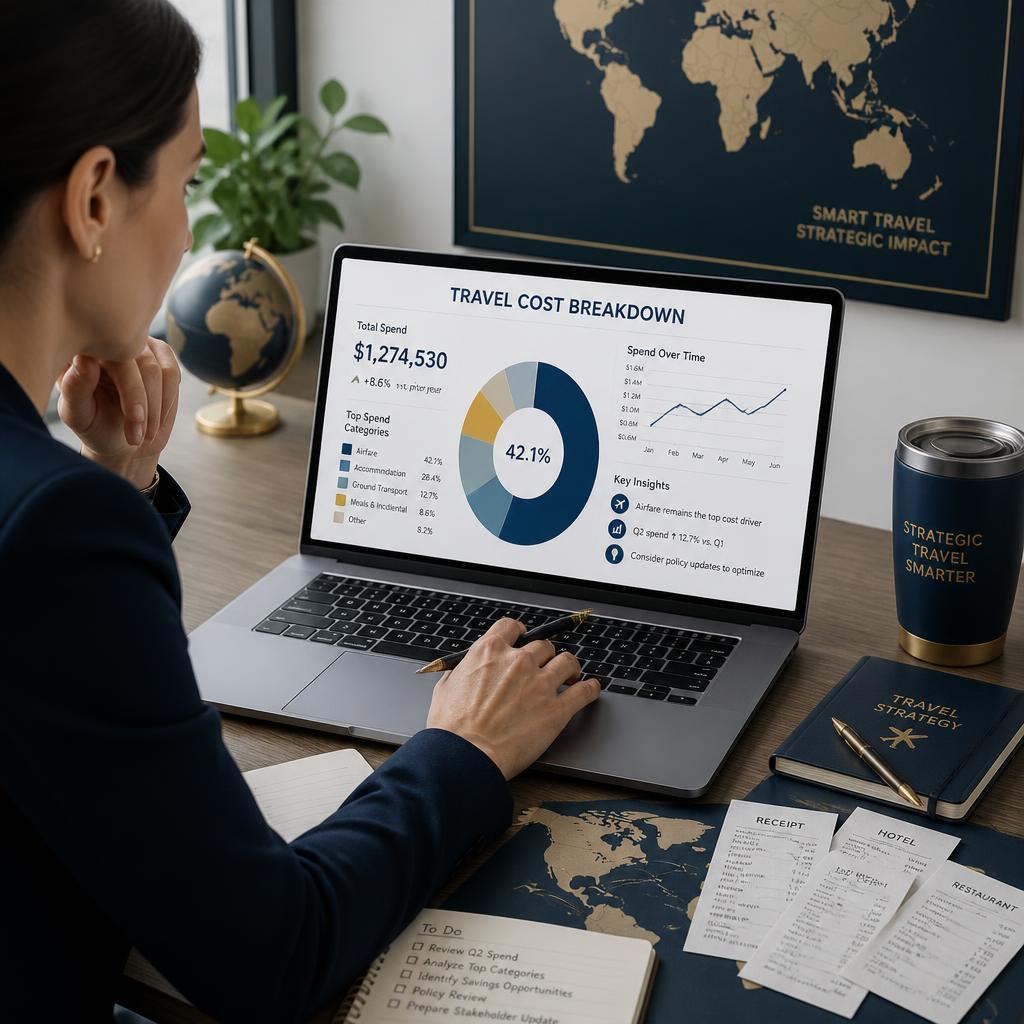
Cutting travel costs is easy. Just book the cheapest flight on the cheapest day and send your executive through three connections. The problem is what happens next. They arrive exhausted. The meeting goes poorly. The deal slips away. Real business travel cost reduction is not about paying less. It is about paying smarter. It is about finding the savings that do not come with a hidden cost in time, energy, or opportunity.
Before we dig into the details, it is vital to have in mind a recent Deloitte’s 2025 Corporate Travel Study which shows a mixed outlook where 74% of travel managers plan to expand budgets in 2025, while 10% anticipate cuts, particularly among large enterprises. Large companies (spending over $7.5 million annually) are disproportionately affected by reductions, with 20% cutting budgets by an average of 35%, compared to only 6% of small firms.
This guide covers the tactics that work. We will look at flights, hotels, ground transport, food, and the technology that ties it all together. Then we will examine the counterintuitive moments when spending more actually saves money.
Why Most Business Travel Cost Reduction Efforts Fail
Most cost reduction programs start with a spreadsheet and end with frustration.
The spreadsheet says the company spent $340,000 on travel last year. The directive comes down: cut it by 15 percent. So the travel manager tightens the booking policy, pushes everyone to economy, and eliminates the “nice” hotels.
Six months later, the numbers show a modest reduction. But the executive team is unhappy. Productivity is down. Two key deals were lost due to fatigue and delays. The savings were real, but the cost was higher.
The failure is not in the intention. It is in the measurement. Cost reduction that ignores time, energy, and outcomes is not optimization. It is amputation.
A better approach starts with a question: where are we spending money that does not produce value?
Business Travel Cost Reduction Without Cutting Quality
The following tactics reduce real costs while preserving the quality that makes travel effective.
Flight Booking Tactics
Airfare is usually the largest single line item in a travel budget. It is also where the most waste hides.
Tactics that work:
- Book 14 to 21 days out. Corporate fares climb sharply inside the seven-day window.
- Fly Tuesday, Wednesday, or Saturday. Monday mornings and Friday afternoons are the most expensive.
- Consider alternate airports. Secondary airports often offer lower fares and faster transit.
- Use corporate fare programs. Even small companies can access negotiated rates.
- Track route-level spend. You cannot optimize what you do not measure.
For teams that want visibility without a full enterprise platform, TravelPayouts offers a consolidated view of airline and hotel pricing. It is a practical starting point for small and mid-size operations.
Hotel Negotiation and Selection For Business Travel Cost Reduction
Hotels are more negotiable than most travel managers assume.
Even without a formal corporate rate, you can often secure better terms by:
- Booking directly with the property for extended stays
- Asking for loyalty program alignment
- Committing to a volume of nights in exchange for a fixed rate
- Booking refundable rates only when schedules are uncertain
Location remains the most important variable. A cheaper hotel far from the meeting location almost always costs more in total.
For teams booking frequently, TravelPayouts aggregates hotel inventory across major chains, which simplifies comparison and can surface rates that do not appear on individual brand sites.
Ground Transport Savings
Ground transport is where budgets leak quietly.
A $45 ride-share here. A $60 black car there. Multiplied across hundreds of trips, the total is substantial—and rarely audited.
Practical reductions:
- Pre-book airport transfers. Surge pricing disappears when you commit in advance.
- Use rail for short intercity routes. Often faster and cheaper than flying.
- Consolidate trips. Two executives traveling to the same city on the same day can share ground transport.
- Negotiate corporate accounts. Even small volumes can unlock discounts.
Pre-booking also reduces the cognitive load on the traveler, which has its own value.
Food and Incidentals
Food and incidentals are the smallest category, but they are also the most visible. Executives notice when per-diems are cut. They also notice when they are reasonable.
A workable approach:
- Set a realistic per-diem that reflects local costs
- Allow higher spend for client meals, which are business development, not perks
- Simplify expense reporting so time is not wasted on reconciliation
The goal is not to nickel-and-dime. The goal is to remove friction from the parts of travel that do not matter, so energy can go to the parts that do.
The Technology Stack for Business Travel Cost Reduction
Technology is where modern cost reduction separates from the old spreadsheet approach.
The essential stack:
- Travel management platform for booking, policy enforcement, and reporting
- Affiliate aggregation tools like TravelPayouts for visibility across providers
- Expense management software for fast reconciliation
- Analytics dashboard to track spend by department, route, and traveler
The specific tools matter less than the principle. You need one place where travel data lives, and you need to look at it regularly.
When Spending More Saves Money

Here is the counterintuitive part.
Sometimes the more expensive option is the cheaper one. This is true in three specific scenarios.
Urgent, high-stakes trips. If the deal is worth seven figures, the difference between a $900 commercial ticket and a $12,000 charter is trivial. What matters is arriving on time and ready.
Multi-city days. Commercial travel makes a three-city day impossible. Private aviation makes it routine. The value of the extra meetings often exceeds the cost of the flight.
Executive time protection. An executive whose hourly value is $1,000 cannot afford to lose four hours to commercial inefficiency. The math favors the faster option.
Villiers.ai specializes in matching travelers with the right aircraft for these scenarios. For companies that fly occasionally but need certainty when they do, on-demand charter is often the answer. You can explore available aircraft and pricing directly on their platform.
The principle is simple: reduce cost where cost does not create value. Spend where it does.
Measuring Success
How do you know if your cost reduction program is working?
Track these metrics:
- Total travel spend — The headline number
- Cost per trip — Adjusted for distance and purpose
- Door-to-door time — The hidden cost most companies ignore
- Traveler satisfaction — A leading indicator of retention and productivity
- Deal influence — Did the trip contribute to revenue?
The last two metrics are harder to measure. They are also the ones that determine whether the program is actually succeeding.
The Bottom Line
Business travel cost reduction is not a race to the bottom. It is a disciplined effort to eliminate waste while protecting the outcomes that justify travel in the first place.
Book smarter. Negotiate hotels. Control ground transport. Use technology. And know when to spend more.
Companies that get this right reduce costs by 15 to 25 percent while improving the experience for the people who travel. Companies that get it wrong save 10 percent and lose the deals that pay for everything else.








Leave a Reply