


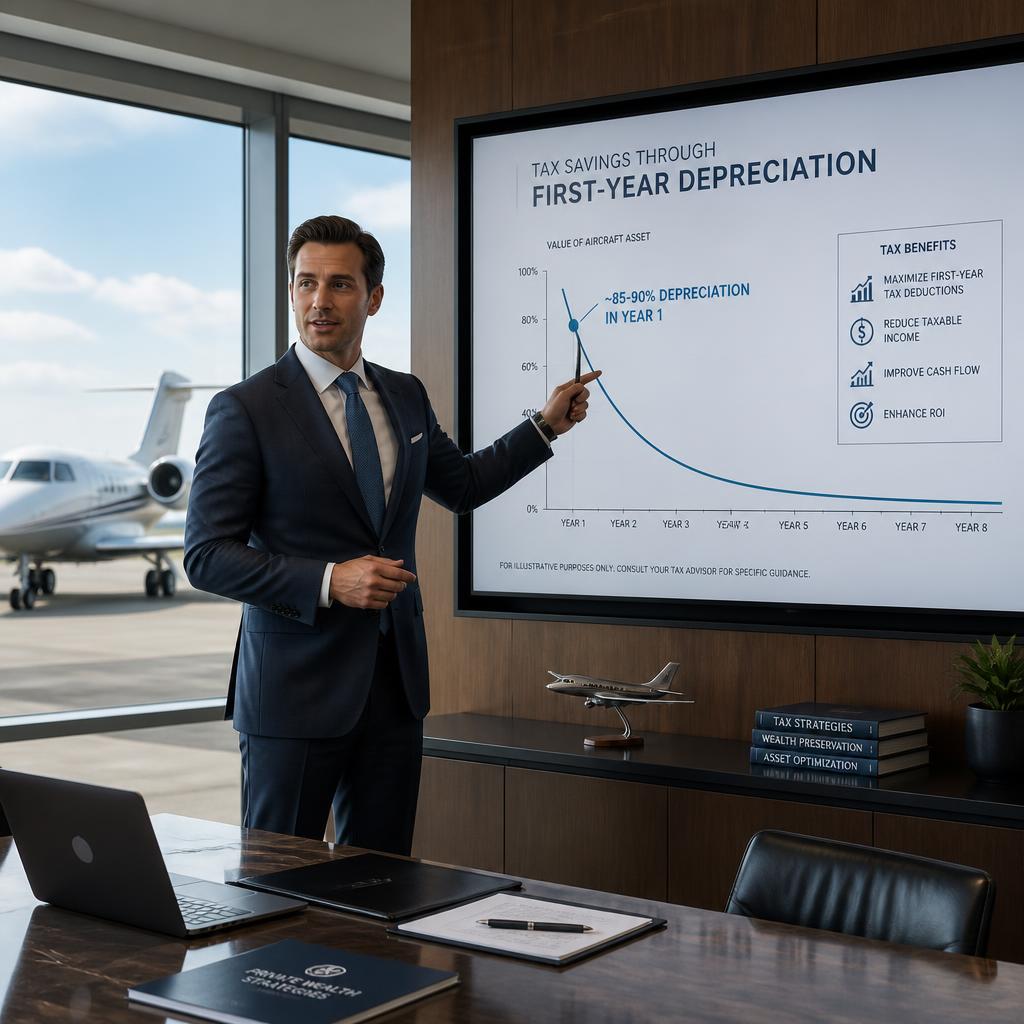
Depreciation devastates private jet economics more than operating costs. Most private jets cost more than $1 million a year to run. They also lose 35% to 50% of their value within five years. Yet some models hold value significantly better than others. Understanding private jet ownership resale value factors is essential before committing to a purchase. This guide breaks down what drives depreciation, which models retain value, and how to time your exit.
The Depreciation Reality
Private jets depreciate over time, affecting the aircraft’s resale value. The rate of depreciation varies dramatically based on model, age, maintenance history, and market conditions.
Entry-level jets like the Eclipse 550 and Citation Mustang lose 35% to 50% of their value within five years. Larger jets can depreciate even more steeply in dollar terms, even if the percentage is similar.
The resale market tells a clear story: pre-owned business jets for sale increased to an average monthly rate of over 1,800 in the first half of 2025, up from 1,744 in the first half of 2024. The average time on market has also increased, to 418 days from 386 days.
Factors That Drive Private Jet Ownership Resale Value
Several key factors determine private jet ownership resale value:
- Model and Brand Reputation: Citation M2s tend to hold value slightly better and resell faster than Phenom 100EVs, partially due to brand familiarity and broader market acceptance. Established brands with large active fleets generally offer greater resale liquidity.
- Maintenance History: A complete, verifiable maintenance record is non-negotiable for resale. Buyers will pay a premium for aircraft with documented service histories and no accidents.
- Total Time and Cycles: Aircraft with lower total time and fewer cycles command higher prices. This is the aviation equivalent of low mileage on a car.
- Avionics Upgrades: Older aircraft with outdated avionics suffer steeper depreciation. Upgraded systems can significantly boost resale value.
- Interior Condition: Wear and tear on the cabin directly affects resale. Well-maintained interiors with modern configurations hold value better.

The 10% Rule
Industry advisors offer a simple guideline: if a private jet costs more than 10% of your net worth, think twice. This rule reflects the reality that private jets are expensive, depreciating assets.
The rule also acknowledges that ownership costs extend far beyond the purchase price. Fixed costs—financing, maintenance, insurance, and depreciation—can push the annual budget to $500,000 or more.
Timing the Market
Market timing significantly affects private jet ownership resale value.
The business aviation market remained fundamentally strong in the first quarter of 2026. North American flight activity is projected to climb 1.9% in 2026, on track to hit roughly 5.5 million flight hours. Fractional and charter operators are leading the charge, with 91% of operators expecting to fly the same or more than they did in 2025.
Nevertheless, the industry is bumping up against a “supply-driven ceiling”. Growth is not limited by a lack of interest but rather by OEM production bottlenecks and a heavily congested maintenance, repair, and overhaul sector. This constraint could support used aircraft values in the near term.
In some specific situations, help may be sought from sources like VREF aircraft valuation guide for expert guidance regarding private jet ownership resale value.
Chartering as an Alternative
For most business travelers, chartering eliminates resale risk entirely.
When you charter, you pay only for the hours you use. No depreciation. No resale concerns. No capital tied up in a depreciating asset.
The break-even point for ownership versus chartering remains roughly 200 flight hours per year. Below that threshold, chartering is almost always the more cost-effective option.
The Bottom Line
Private jet ownership resale value depends on model selection, maintenance discipline, and market timing. The most successful owners treat their aircraft as business assets—not toys—and plan their exit strategy before they even enter the market.
Villiers.ai offers an alternative to ownership. With access to thousands of aircraft and no depreciation risk, chartering delivers the mobility without the asset exposure.







Leave a Reply